The position, stated up front
We quote no provider prices anywhere in this article. Prices change quarterly and a number written today would be wrong by the time you read it. What does not change is the shape of the model, so put your own figures into it.
The AI agent cost formula
Cost per completed task, with every term visible:
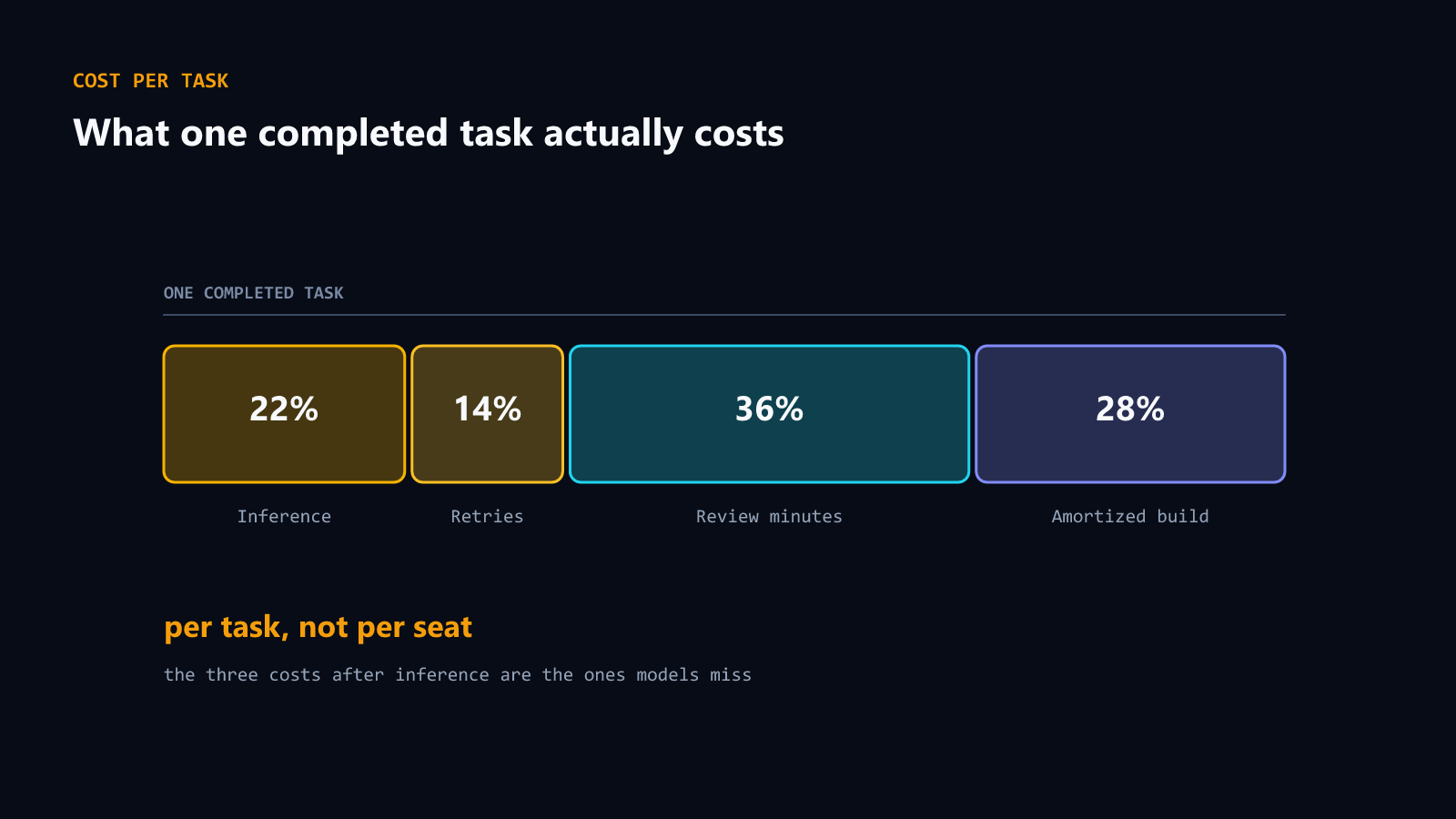
Five terms. Most vendor comparisons show you the first one, and most of the money is in the third.
Term by term, and where it goes wrong
An agent that fails and retries pays for both runs. Worse, a failing run is often the longer one: it retrieves more, reasons for longer and produces more output before giving up. A retry rate of one in five does not add a fifth to your inference bill. It adds more, and it adds latency on the path where a human is waiting.
This is why verification and eval work is a cost control, not a quality luxury. Every failure you catch at the unit that caused it is a failure you retry cheaply instead of re-running the whole job.
Here is the mechanism that surprises teams most. Retrieval quality and cost are the same problem.
Suppose the answer to a task lives in three passages, and your retriever returns twenty because nobody tuned it. You now pay for those seventeen extra passages on every call, forever. The bill scales with the number of tasks, and the waste is proportional. Tightening retrieval to the passages that carry the answer cuts the input term several times over and usually raises accuracy at the same time, because the model is no longer choosing between competing sources.
If the input side of your bill grows faster than your task count, the cause is nearly always context that grew by accident. That is a retrieval design question before it is a pricing one.
Take a task an experienced person completes in nine minutes. If an agent does it and a human spends four minutes checking the result, you have not saved nine minutes. You have saved five, and you are paying for inference on top.
So the number that matters is not accuracy. It is the share of output that ships without a human touching it, and the share that a human has to open. Model that explicitly:
Read that formula for a moment and the strategy falls out. Halving the escalation rate on a task with heavy review does more for cost than any model switch. This is the whole reason we widen autonomy against a measured pass rate rather than shipping it on day one: every point of measured accuracy converts directly into fewer reviewed cases.
Scoping, integration, evals, guardrails and rollout are a fixed cost. Divided across a process that runs 200 times a day, it disappears within the first year. Divided across a process that runs weekly, it never does.
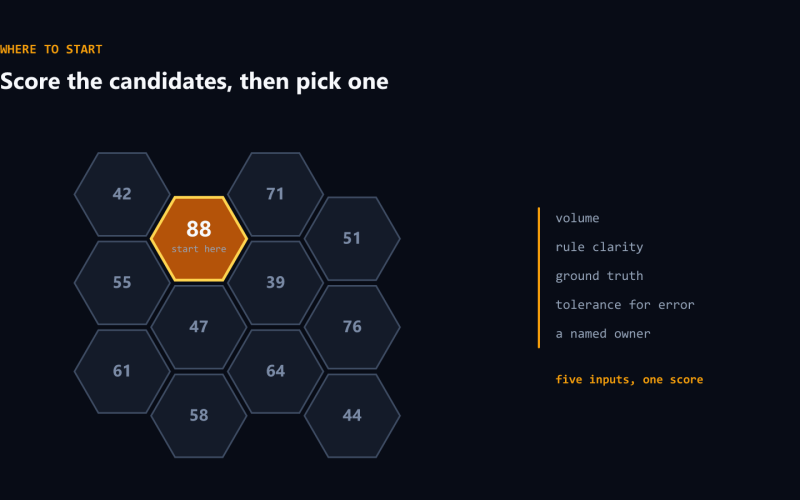
That is the arithmetic reason volume is on the first-process scoring method, and the reason we will tell you when a process is too small to be worth building for.
Evals rerun on every model version. Retrieval indexes rebuild. Providers deprecate models and something has to be re-tested. Somebody watches the drift alarms. This is ordinary operational cost, it is predictable, and a plan that omits it is a plan that will be renegotiated. It is the work we sell as managed AI agents, and it exists whether or not anyone sells it to you.
Three levers, ranked by what they return
If a cost per task is too high, work these in order. The ranking is deliberate: the first two are usually worth more than any model decision, and both improve accuracy as a side effect.
The order is not arbitrary. Model switching is the most visible lever and usually the smallest, and it is the only one of the three that can quietly cost you accuracy while saving money.
Why per-seat pricing misprices this
A seat price assumes cost scales with people. Agent cost scales with tasks. Those two things come apart in both directions, and the gap is where the mispricing sits.
A five-person support team handling a seasonal spike buys five seats and processes triple the volume in November. The vendor’s costs rise and yours do not, so the price has to be padded for the worst case, which means you overpay for the other eleven months.
The reverse is worse. A team that automates well needs fewer people, so the seat count falls while the task count rises. Under seat pricing your bill goes down as your usage goes up, which no vendor will sustain, so the terms get rewritten at renewal.
Per-task pricing has an honesty property that per-seat does not: it moves in the same direction as the value delivered. It also forces both sides to know the number. A vendor who cannot tell you their cost per task has not measured it.
Comparing against the human number properly
Two mistakes are almost universal here.
There is a third factor that no model captures well: the tasks that get done at all. Overnight coverage, weekend queues, and the follow-ups that quietly never happen. It is real value and we deliberately leave it out of the model, because a number we cannot defend is worth less than an honest gap.
What our model deliberately does not count
Four things, stated plainly.
A worked example on ticket triage makes the shape concrete: high volume, short tasks, cheap and reversible errors, and a review burden that falls as the pass rate is measured and autonomy widens. The same arithmetic runs against overnight infrastructure work, where the human minute being offset is one at 3 a.m.
- Integration effort on your side - Access, credentials, a sandbox, and someone’s time to answer questions.
- Change management - People need to be told what the agent owns and what they still own.
- Review time in the first weeks - During shadow and assisted stages, the agent costs time rather than saving it. That is the price of evidence.
- Second-order gains - Faster responses, fewer escalations, better data. Real, and not modelable without inventing a number.
The short version
- Cost per task, not per seat. Seats do not scale with the work an agent does.
- Retries multiply the inference term, and failing runs are usually the expensive ones.
- Untuned retrieval is a permanent tax on every call. Fix it and quality improves at the same time.
- Review minutes usually dominate. The lever is the escalation rate, not the model.
- Compare marginal costs against loaded human costs, never averages against salary.
- Any cost model worth trusting names what it deliberately does not count.
Keep reading
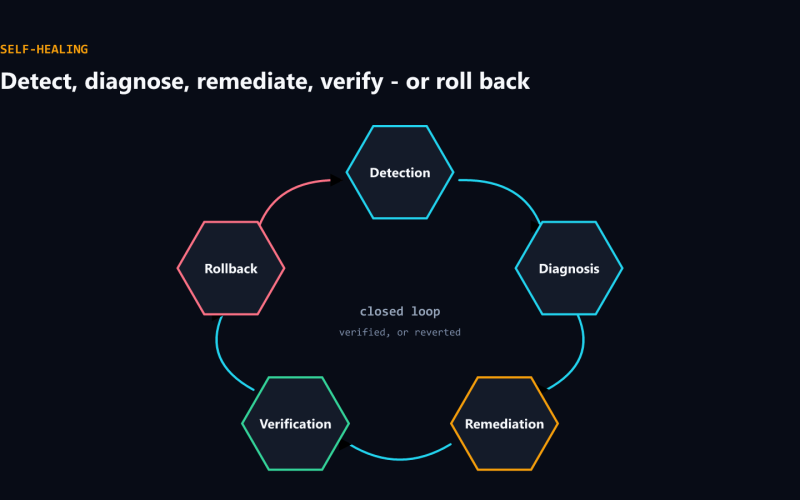
- Self-healing systems: agents that fix themselves - The same arithmetic applied to work that happens while everyone is asleep.
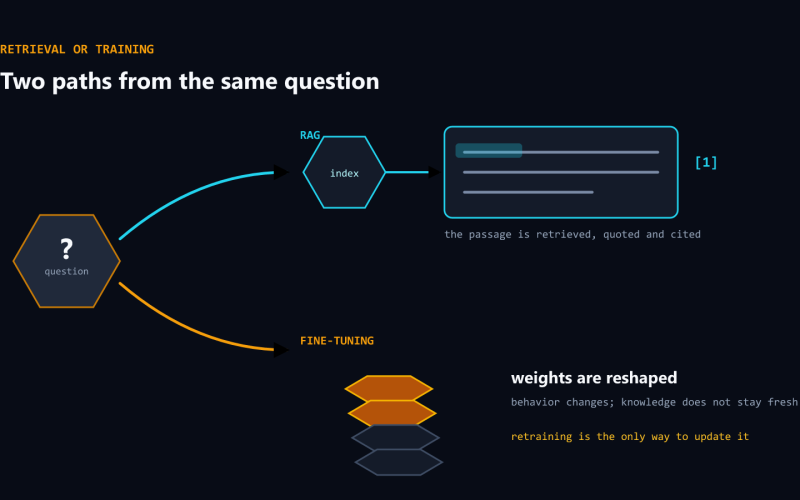
- RAG or fine-tuning? A decision guide that isn’t vendor marketing - The retrieval and model choices that set your input costs.
- Questions, answered - Cost, safety, timelines and what stays human.