
AUTONOMOUS AI AGENTS · ORCHESTRATED
Your AI workforce, orchestrated.
URU Forge is an AI engineering company. We build AI agents for business - autonomous, coordinated and governed - engineer the LLM layer they run on, integrate them into the software you already use, and then operate them, so the work of skilled professionals across engineering, marketing, sales, support, finance and operations happens 24 hours a day. A human is always one click from the controls.
AI development · LLM engineering · Integration · Managed 24/7
What an AI workforce changes, in four numbers
- 24/7
- Coverage without shift premiums
- ~70%
- Of routine task volume typically automatable
- <30 days
- From audit to first agent in production
- 100%
- Of agent actions logged and auditable
Typical ranges from our engagement model. Your numbers come out of the readiness audit - we don't guess them for you.
THE COST OF DOING IT BY HAND
Skilled people are spending their week on work that never needed a person.
Ticket triage. Invoice matching. Lead research. Release chores. Report assembly. Each one is small. Together they consume the most expensive hours in your business, and they scale only by hiring.
Scripts break the moment the input changes. Point tools automate one step and hand the rest back. What’s missing isn’t a tool. It’s coordination.
HOW A HIVE WORKS
A hive, not a chatbot.
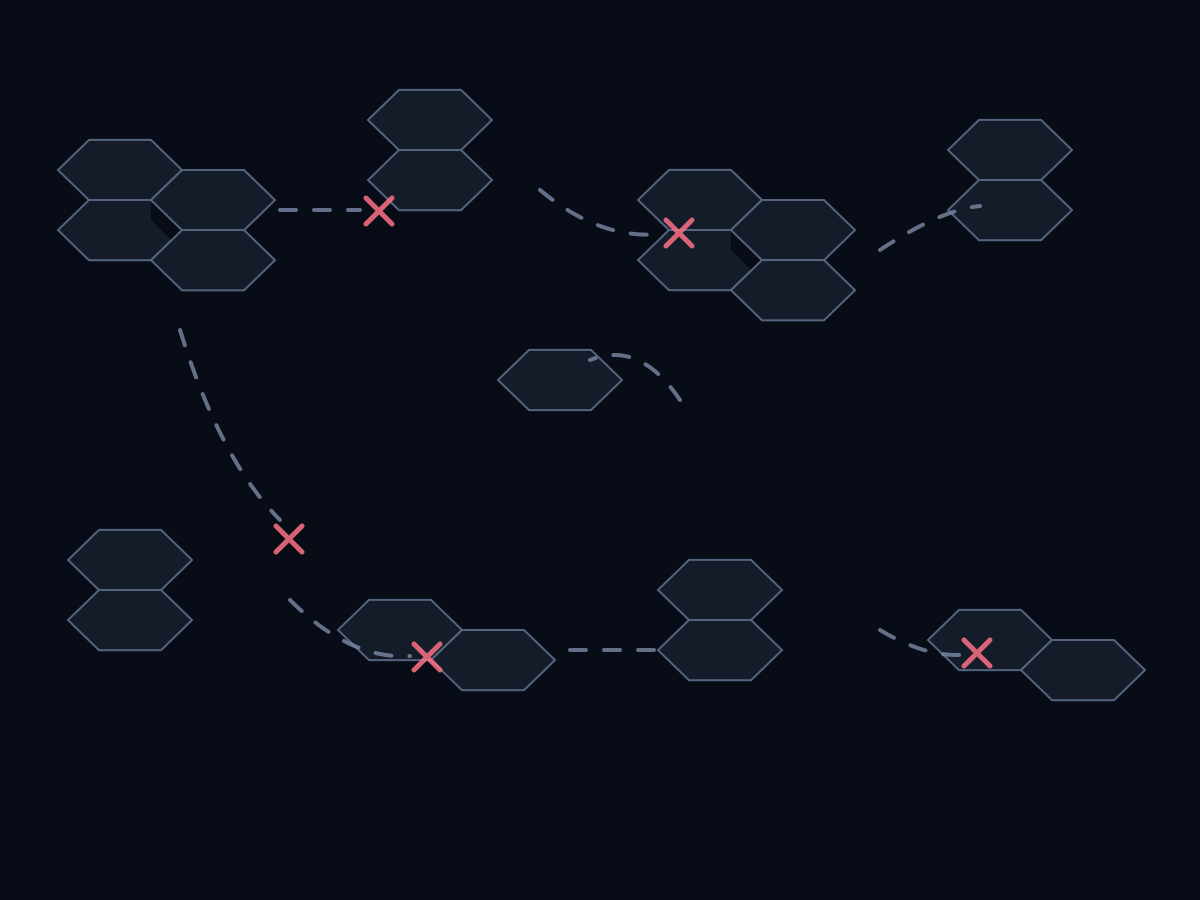
Drop a process into the hive and watch what happens: the orchestrator breaks it into tasks, dispatches a specialist agent to each one, checks the result, retries what fails, repairs what breaks, and escalates the one thing that genuinely needs you.
New support ticket
Receive
A ticket arrives by email, chat or the portal. The orchestrator reads it and identifies the customer.
Classify
A triage agent tags type, urgency and product area, then pulls the account history.
Retrieve
A knowledge agent finds the answer in your documentation and cites where it came from.
Act
The agent drafts the reply, applies a credit inside its limit, and updates the ticket.
Escalate
Anything outside the limit goes to a person, with the context and a recommended action attached.
Self-healed - retried with fallback tool. Human not required.
Supplier invoice arrives
Receive
The invoice lands by email or supplier portal. Line items, totals and dates are extracted.
Match
A matching agent finds the purchase order and the goods receipt, and compares them line by line.
Check
Tolerances, duplicates, tax treatment and changed bank details are tested against your rules.
Post
Clean invoices are posted to the ledger and queued for payment.
Self-healed - retried with fallback tool. Human not required.
Escalate
Mismatches stop and wait for a named approver, with the discrepancy already highlighted.
Deploy fails at 3 a.m.
Detect
The pipeline fails. A monitoring agent notices before the alert reaches anyone's phone.
Diagnose
It reads the logs, the diff and the last green build, and forms a probable cause.
Repair
Known failure classes get a known fix: retry, roll back, clear the cache, pin the dependency.
Self-healed - retried with fallback tool. Human not required.
Verify
It reruns the pipeline and confirms the service is healthy before standing down.
Escalate
An unknown failure wakes a person, with the trace, the diff and everything already tried.
Orchestrated
Agents coordinate, hand off, retry and escalate, so a whole process finishes rather than one step of it.
Self-healing
Agents watch themselves and each other, and most failures are detected and repaired before anyone notices them.
Governed
Autonomy boundaries, approval gates and audit logs are agreed at the blueprint stage, not added after an incident.
Integrated
Agents work inside your CRM, ERP, helpdesk, repositories and warehouse, not alongside them in a separate tab.
WHAT WE BUILD
Four disciplines, one outcome
Most agencies sell you a model. As an AI development company we build the whole system: the agents, the engineering underneath them, the wiring into your stack, and the operation that keeps them working in month six.
We build the system.
AI Development
Autonomous agents, custom machine-learning models, generative-AI products, and AI features inside software you already own.
AI Agent Development · Custom AI & ML Development · Generative AI Development · Software Development Agents · AI Readiness Audit
We engineer the layer underneath.
LLM Engineering
Retrieval, memory, tool design, fine-tuning, evaluation harnesses and model routing. This is the difference between a demo that impresses and a system that still works in month six.
LLM Engineering · RAG & Knowledge Systems · Fine-Tuning & Evaluation · Conversational AI & Voice Agents
We wire it into what you already run.
AI Integration
CRM, ERP, helpdesk, repositories, warehouses and the legacy API nobody wants to touch, plus the orchestration and data engineering that keeps it coherent.
AI Integration & Implementation · Agent Orchestration · Data Engineering for AI · Self-Healing Infrastructure
We put it to work, and we run it.
Autonomous Workforce
Agents that do the job of skilled professionals across every department, operated and improved by us or handed over to your team.
Business Process Automation · Marketing Agents · Sales Agents · Customer Support Agents · Finance & Back-Office Agents · Managed AI Workforce
MEET THE SWARM
Twenty-four autonomous AI agents, each with one job
Every agent is a specialist. It owns a narrow task, uses the cheapest model that clears the quality bar, and hands off to a human at the point you decide.
Ticket Triage Agent
Reads every incoming ticket, tags it, finds the answer and drafts the reply.
Lead Research & Enrichment Agent
Researches each new lead and fills the CRM before a rep opens it.
Code Review Agent
Reviews every pull request for defects, style and risk, and flags what a person should read.
Invoice Matching Agent
Matches invoices to purchase orders and receipts, and stops the ones that don't.
SEO Content Agent
Researches, briefs and drafts, then routes to a human editor before anything publishes.
Self-Healing Infra Agent
Detects, diagnoses and repairs infrastructure failures, and escalates what it can't fix.
HOW WE WORK
From "which process?" to production in weeks, not quarters
-
Scout
We map your workflows and score every candidate process on value, feasibility and risk.
-
Blueprint
Agent roles, autonomy boundaries, escalation paths and success metrics, agreed before any code.
-
Prototype
One agent, your real data, measured for accuracy, latency and cost per task.
-
Forge
The production build: integrations, orchestration, retries, observability and deployment.
-
Guard
Eval suites, approval gates, audit logging, cost ceilings and kill switches.
-
Release
Shadow mode, then assisted, then autonomous, once the pass rate holds.
-
Tend
We watch the evals, swap in cheaper models that still clear the bar, and add agents.
What actually changes
| Measure | Humans alone | Humans + Hive |
|---|---|---|
| Coverage | Business hours, minus leave, minus sickness. | Every hour of every day, with the same rules at 3 a.m. as at 3 p.m. |
| Throughput ceiling | Rises only when you hire. | Rises with volume. Capacity is added in hours, not hiring cycles. |
| Cost per task | The loaded hourly cost of the person doing it. | A model call and a few seconds of compute, measured per task. |
| Time to first response | Whenever someone next opens the queue. | Seconds, with the context already gathered. |
| Consistency | Varies by person, by day, by workload. | The same procedure every time, and every deviation is logged. |
| Where your people spend their week | Clearing the queue. | Handling exceptions, judgment calls and customers. |
These are shapes, not promises. Model your own numbers
Built for how your sector actually operates
FinTech
Reconciliation, onboarding checks and exception queues.
HealthTech
Intake, coding and prior-authorization paperwork.
eCommerce & Retail
Catalog enrichment, order exceptions and ad operations.
Logistics & Supply Chain
Shipment exceptions, documents and supplier chasing.
SaaS & Technology
Support triage, release chores and churn signals.
Professional Services
Proposals, research, reporting and timesheet chasing.
Real Estate & Property
Listings, inquiries, viewings and compliance packs.
Manufacturing
Purchase orders, quality logs and maintenance tickets.
RUNS IN YOUR STACK
AI agents work where your work already lives
CRM, ERP, helpdesk, repositories, ad platforms, data warehouse, email and chat. If it has an API, an agent can use it. If it doesn't, we'll build the bridge.
- CRM
- ERP
- Helpdesk & ticketing
- Code repositories
- CI/CD
- Data warehouse
- Ad platforms
- Email & calendar
- Chat
- E-commerce
- Accounting
- Identity & access
Platform names are shown as examples of the categories agents connect to. They are not partnerships or endorsements.
TRUST IS ARCHITECTURE
Autonomy with a handbrake
Autonomy boundaries
Every agent has a written limit on what it may do alone, agreed before it is built and enforced in code.
Human-in-the-loop
Anything irreversible passes an approval gate: a named person, a real decision, a recorded outcome.
Full traceability
Every action, input, tool call and model call is logged, so you can reconstruct any decision after the fact.
Data control
Your data, your residency. It is never used to train a public model, and access is scoped per agent.
What a hive looks like in practice
Reference scenarios - composite builds that illustrate our method. Figures are modeled, and the model is shown on each page.
Frequently asked questions
Is this just a chatbot with a new name?
No. A chatbot answers; an agent acts. An agent has a defined job, permission to use your tools, a record of what it has already done, and an escalation path when it reaches its limit. A hive goes further: an orchestrator splits a process into tasks, hands each to a specialist agent, checks the result and retries what fails. The visible difference is that work finishes without anyone opening a chat window.
What's the difference between AI development, LLM engineering and automation?
AI development is building the system: the agents, the models and the product around them. LLM engineering is the layer underneath - retrieval, memory, tool design, evaluation and model routing - and it decides whether the system still works in month six. Automation is the outcome: a process that runs without a queue. Most projects need all three. Most disappointing projects bought only the first.
How long before the first agent is doing real work?
Typically under 30 days from readiness audit to an agent running in production on a narrow task. The audit takes 3-10 days, the blueprint one to two weeks, and a prototype on your real data two to four weeks, with the first agent often running in shadow mode before the full build finishes. Broad, cross-system processes take longer. We tell you which one you have before you commit.
What happens when an agent gets something wrong?
It is caught, logged, and either repaired or handed to a person. Every agent has a written autonomy boundary, an approval gate on anything irreversible, and a confidence threshold below which it escalates instead of guessing. Failed tasks are retried with a different approach, and repeated failures raise an alert with the full trace attached. Nothing an agent does is invisible.
Does our data get used to train someone else's model?
No. We contract for zero training rights with every model provider we use, and we prefer deployments where your data never leaves your tenancy. You choose the residency. Retrieval indexes are built inside your boundary, access is scoped per agent, and every read is logged. Where a provider's terms can't meet that, we route the task to one that can.
Do we need an AI team to run this?
No, and most clients don't have one. We can run the hive as a managed service: we watch the evals, swap in cheaper models that still clear the quality bar, repair drift and report every month. If you would rather own it, we build to hand over, with the runbook, the eval suite and training for your team. Plenty of clients start managed and take the controls later.