The position, stated up front
Value matters. It is the second question, and every scoring method that puts it first produces the same expensive result.
Which processes to automate with AI: the five-step method
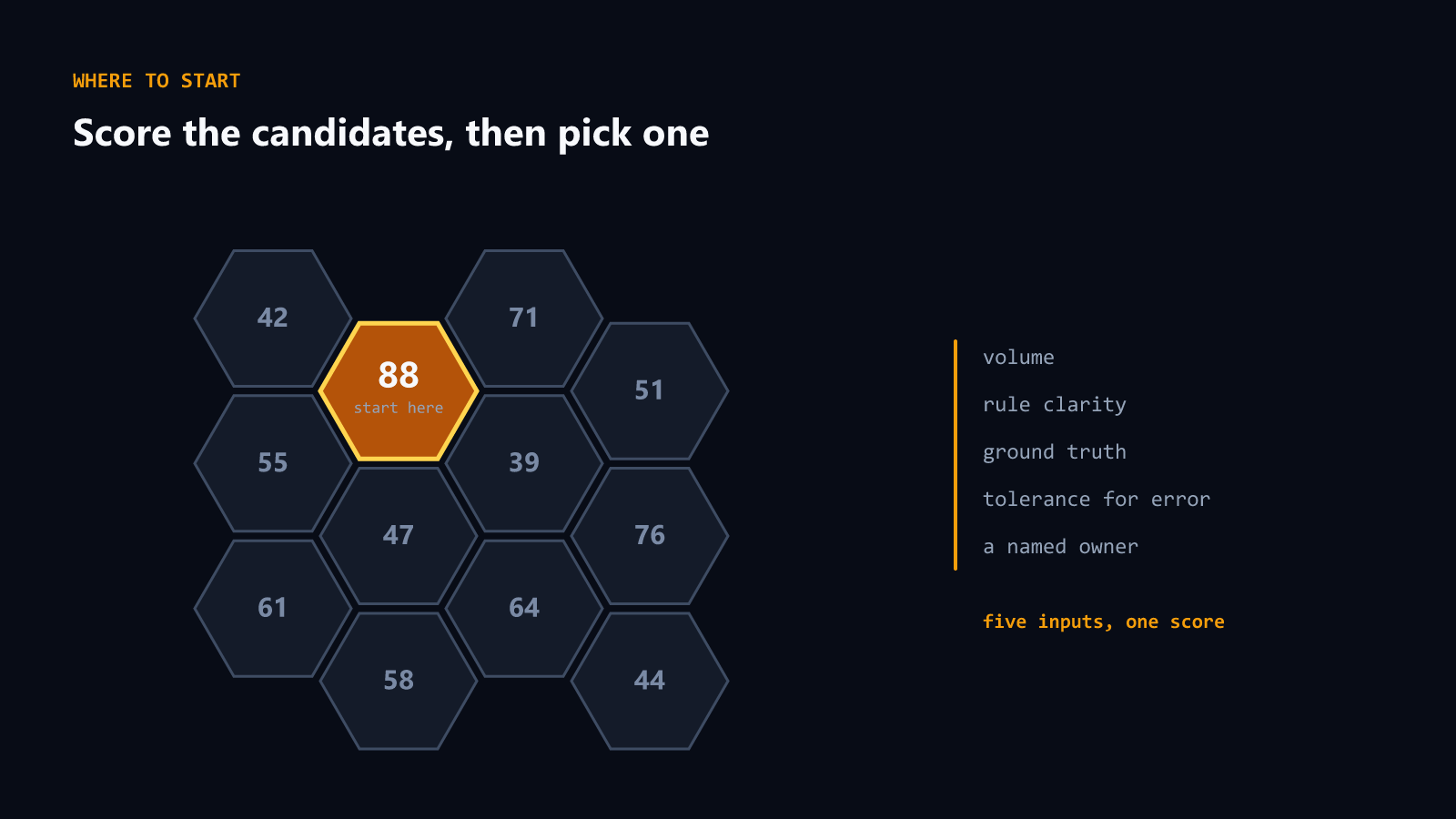
Score each candidate process on all five. The first four are scored; the fifth is a gate.
Count how often the process runs and how long one instance takes. Frequency times handling time is the size of the prize, and it is the only number in this method that anyone ever collects.
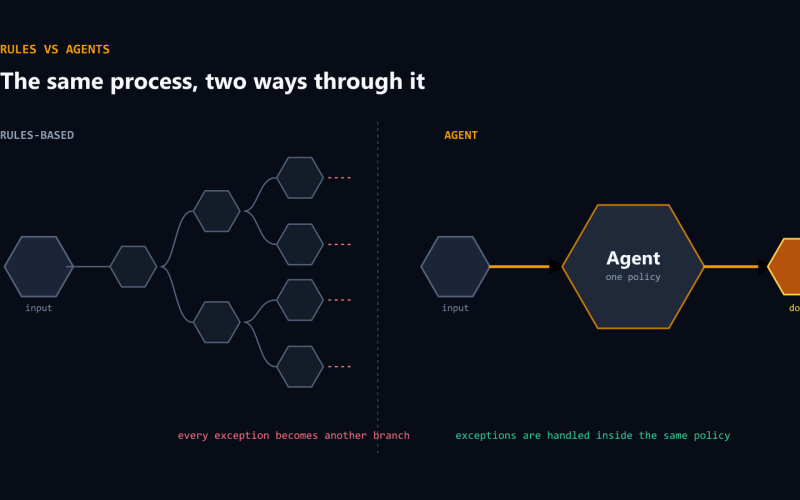
Then collect the number almost nobody has: the spread. If most instances take a few minutes and a small share take an hour, the long tail is where the cost actually lives, and it is usually where the judgment lives too. A process with high volume and no spread is a scripting problem, not an agent problem.
Sit with the two people who do this work and ask them to write down how they decide. Do it separately.
Compare the answers. Where they agree, you have rules an agent can be given. Where they disagree, you have either an undocumented policy or a genuine judgment call, and you need to know which before anyone builds. This exercise takes an afternoon and it is the highest-value hour in the whole assessment.
Two separate questions, both required.
Price a single wrong action, then ask a second question that matters more: how long does it take to undo?
A misrouted ticket is wrong for eleven minutes. A wrongly issued refund is wrong until someone notices, and an incorrect filing may be wrong until an auditor finds it. Same error rate, entirely different risk.
Reversibility is the axis that decides where the approval gate sits rather than whether to build at all. Cheap and reversible errors can run autonomously early. Expensive or irreversible ones stay behind a human approval permanently, and that is a fine outcome: the agent still does the reading, the finding and the drafting, and a person still presses the button.
Name the person. Not the department, not the steering committee. One person who will see the exception queue, set the quality bar, and be told first when the agent gets something wrong.
This is a gate, not a score. Processes without a single owner fail for reasons that have nothing to do with technology: nobody defines the bar, so nobody accepts the result, and the pilot circles until it is quietly defunded. If you cannot name the person in one sentence, pick a different process. That is the cheapest decision in this article.
Scoring, and what to do with the result
Run every candidate through it and rank them. Then ignore the ranking for a moment and check the top three against one more question: which of these could show a result inside a quarter? A smaller process that delivers in six weeks buys you the credibility to attempt the large one. A large process that delivers in nine months spends that credibility before producing anything.
This is exactly the scoring we run in the AI readiness audit, against your own workflows and with your own numbers. Typically 3-10 days, and the output is a scored backlog rather than a recommendation to buy something.
| Axis | Weight | What a high score looks like |
|---|---|---|
| Volume and shape | 25% | Runs daily, with a real spread in handling time |
| Rule clarity | 25% | Two practitioners describe the same rules |
| Data access | 20% | Every input reachable through an API with scoped credentials |
| Cost of error and reversibility | 20% | Errors are cheap, visible fast and undoable |
| Ground truth | Gate | A labeled history exists |
| Named owner | Gate | One person, named, who accepts the output |
Two candidates, scored
Abstract methods are easy to agree with and hard to apply, so here are two processes from the same mid-sized business, run through the same scoring.
Candidate A is the process the business cares more about, and it fails the ground-truth gate outright. There is no way to prove an agent is doing it well, so autonomy could never widen and the review burden would never fall. It might still be worth building a drafting assistant for, with a lawyer approving every output. It is not a first agent.
Candidate B scores lower on ambition and higher on everything that determines whether a first project finishes. It also produces the artifact that makes the second project easier: a measured pass rate that an executive can read.
That is the pattern almost every time. The process worth automating first is rarely the one anyone would have nominated in the meeting.
| Axis | Candidate A | Candidate B |
|---|---|---|
| Volume and shape | Low frequency, high variance | High frequency, moderate variance |
| Rule clarity | Partly tacit | Written and agreed |
| Data access | Documents in email threads | Structured intake with an API |
| Cost of error, reversibility | High, slow to surface | Low, visible within a day |
| Ground truth | Absent | Present |
| Named owner | Yes | Yes |
Three traps
What good first candidates have in common
Across the assessments we run, the processes that score well share a shape. High frequency. A written or writable rule set. Structured or semi-structured inputs. A decision that is checkable after the fact. Errors that surface within a day. And one person who is visibly relieved to be talking about it.
Ticket triage, invoice matching, lead enrichment, document intake and first-line infrastructure response all tend to fit. Not because those are the most valuable processes in a business, but because they are gradeable. Once one is live and measured, the second is easier to justify and the third is easier still.
There is one more category worth mentioning, and it is often overlooked because it does not sit in a business unit at all: the overnight operational work your engineers absorb. That path is covered in self-healing systems.
What to do before you build anything
Four things, in order, none of which require a vendor.
1. Write down the decision rules with the people who apply them. Keep the disagreements visible. 2. Assemble the labeled history. If it takes more than a week to find, that is the finding. 3. Agree the quality bar as a number, and agree it before anyone has seen a demo. Bars set after a demo are set to whatever the demo achieved. 4. Decide the escalation path and the person at the end of it.
Do those four and the build is mostly execution, which is the phase of business process automation that behaves predictably. Skip them and the build becomes an argument about whether the thing is working.
The short version
- Pick the process you can grade. Ground truth is a gate, not a scoring axis.
- Score volume and shape, rule clarity, data access, and the cost and reversibility of an error.
- Two practitioners describing the rules differently is a finding, not a delay.
- If no single person owns the outcome, choose another process.
- Reversibility decides where the approval gate sits, not whether to build.
- A small win in six weeks is worth more than a large one in nine months.
Keep reading
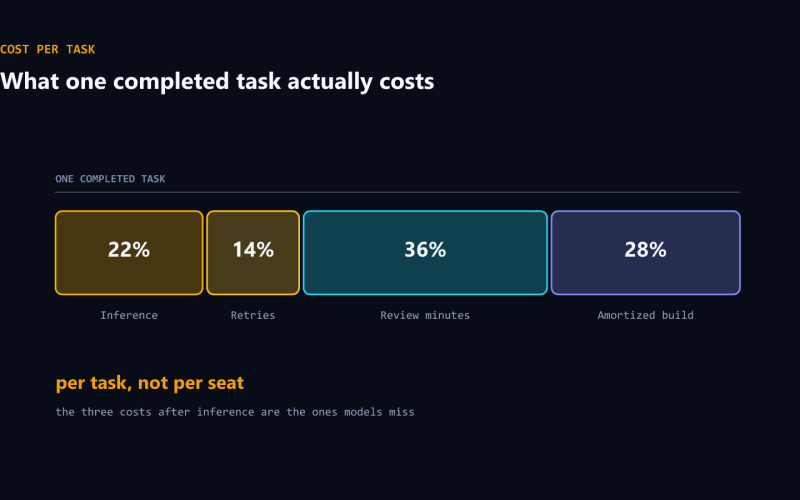
- What AI agents actually cost (per task, not per seat) - Once you have a candidate, work out what running it costs.
- Self-healing systems: agents that fix themselves - The overnight operational work that rarely shows up on a process list.
- Questions, answered - Cost, safety, timelines and what stays human.